
 By BSTeam
 Every founder eventually hits the same fork in the road: register a Private Limited Company under the Companies Act, 2013, or form a Limited Liability Partnership (LLP) under the LLP Act, 2008? It sounds like a small administrative choice at first. It isn’t. The structure you pick decides how much tax you pay, how easily you can raise funding, how much compliance paperwork you’ll file every year, and how painful (or painless) it is to bring in investors, ESOPs, or new partners later.
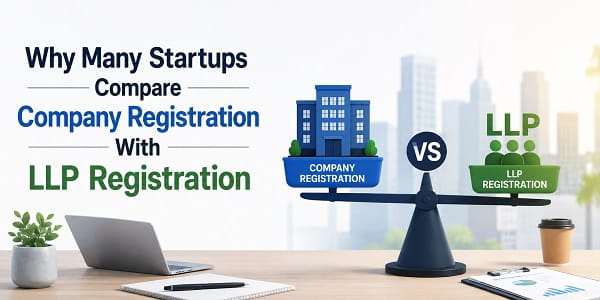
This is exactly why Company Registration and LLP Registration are the two most-compared entity types among Indian startups today. Both offer limited liability protection and both are registered with the Ministry of Corporate Affairs (MCA) – but that’s largely where the similarity ends. One is built for scale and equity fundraising; the other is built for lean, low-compliance operations.
What Is Company Registration?
Company Registration is the process of incorporating a business as a Private Limited Company under the Companies Act, 2013, through the MCA’s SPICe+ (INC-32) form, granting it a separate legal identity, limited liability, and the ability to issue shares.
A Private Limited Company (Pvt Ltd) is defined under Section 2(68) of the Companies Act, 2013, as a company with a minimum of 2 and a maximum of 200 members, restricted transferability of shares, and a prohibition on inviting the public to subscribe to its securities. Completing a Private Limited Company registration grants the business a distinct legal identity and limited liability. Because ownership is divided into equity shares, it remains the preferred vehicle for founders planning to raise venture capital, issue ESOPs, or eventually list publicly.
Did You Know? Since the Companies (Amendment) Act, 2015, there is no statutory minimum paid-up capital required to incorporate a Private Limited Company – you can technically start with as little as ₹1, though most founders start with ₹1 lakh to ₹5 lakh for credibility with banks and vendors.
What Is LLP Registration?
LLP Registration is the process of forming a Limited Liability Partnership under the LLP Act, 2008, combining the operational flexibility of a partnership with the limited liability protection of a company.
An LLP is a hybrid structure – partners manage the business directly (like a traditional partnership), but their personal liability is limited to their agreed contribution, and the LLP itself is a separate legal entity that can own property, enter contracts, and sue or be sued in its own name. Internal management, profit-sharing, and decision-making are governed by the LLP Agreement, giving founders far more contractual freedom than the rigid board-and-shareholder structure of a company.
Why Do Startups Compare Company Registration With LLP Registration?
Founders don’t compare these two structures out of curiosity – they compare them because the wrong choice creates real business friction later. Here’s why the comparison matters so much:
- Both look similar on paper. Both offer limited liability, both are MCA-registered, both are separate legal entities with perpetual succession, and neither requires minimum capital. Founders naturally assume they’re interchangeable – they’re not.
- Funding plans decide the winner. Investors overwhelmingly prefer Pvt Ltd companies because they can hold equity shares, issue ESOPs, and go through structured due diligence. Most VCs and angel investors will not fund an LLP.
- Compliance cost differs meaningfully. LLPs file far fewer annual returns than companies, making them attractive for consultancies, agencies, and professional-services firms that don’t plan to raise institutional capital.
- Conversion later is expensive and time-consuming. Switching from an LLP to a Pvt Ltd company (a common move once a startup starts fundraising) involves a fresh incorporation process, asset transfer, and regulatory filings – costing both time and money that could have been avoided with the right choice upfront.
- Taxation structures genuinely diverge. LLPs are taxed as a flat-rate pass-through-style entity, while companies benefit from concessional corporate tax regimes – but face dividend taxation on distribution.
Company Registration vs LLP Registration: Key Differences
| Feature | Private Limited Company | LLP |
| Governing Law | Companies Act, 2013 | LLP Act, 2008 |
| Registration Form | SPICe+ (INC-32) on MCA V3 portal | FiLLiP form on MCA portal |
| Minimum Members | 2 shareholders, 2 directors | 2 designated partners |
| Maximum Members | 200 shareholders | No upper limit on partners |
| Minimum Capital | No statutory minimum | No statutory minimum |
| Ownership Structure | Equity shares, transferable | Partner contribution, governed by LLP Agreement |
| Liability Protection | Limited to shareholding | Limited to agreed contribution |
| Taxation | 25%/22% (concessional) or 30% + dividend tax on distribution | Flat 30% + 12% surcharge (if income exceeds ₹1 crore); partner’s share exempt under Section 10(2A) |
| Statutory Audit | Mandatory, regardless of turnover | Mandatory only if turnover > ₹40 lakh or contribution > ₹25 lakh |
| Annual Compliance | Higher (Board meetings, AGM, financial statements, ROC filings) | Lower (Form 8, Form 11 annually) |
| Fundraising from Investors | Preferred by VCs, angel investors, PE funds | Rarely funded by equity investors |
| ESOP Issuance | Permitted | Not permitted |
| FDI | Allowed under automatic route in most sectors | Allowed only in specific sectors, more restrictive |
| Ideal For | Startups planning to scale, raise funding, or issue ESOPs | Professional firms, consultancies, low-compliance small businesses |
Liability Protection: The Common Ground
Both structures give founders genuine peace of mind on this front. In a Private Limited Company, a shareholder’s liability is capped at their shareholding. In an LLP, a partner’s liability is capped at their agreed contribution. Neither structure exposes personal assets – like your house or personal savings – to business debts, provided there’s no fraud or personal guarantee involved.
Taxation: Where the Real Difference Shows Up
This is usually the single biggest deciding factor for founders once they model out their numbers.
- LLP Taxation: LLPs are taxed at a flat 30% on total income, plus a 12% surcharge if income exceeds ₹1 crore, plus applicable Health and Education Cess. There are no slab-based concessions. However, once tax is paid at the LLP level, partners can withdraw their share of profit tax-free under Section 10(2A) of the Income Tax Act – there’s no additional layer of taxation on distribution.
- Company Taxation: A Private Limited Company opting for the concessional regime under Section 115BAA pays an effective rate of roughly 25.17% (22% base rate + surcharge + cess). Companies opting for Section 115BAB (new manufacturing companies) can pay as low as 15%. However, when the company distributes profits as dividends, that dividend is taxable in the shareholder’s hands – creating a layer of taxation that LLPs avoid.
Compliance Requirements Compared
| Compliance Aspect | Private Limited Company | LLP |
| Annual Return | MGT-7/MGT-7A (ROC) | Form 11 |
| Financial Statements | AOC-4 (ROC) | Form 8 (Statement of Account & Solvency) |
| Board/Partner Meetings | Minimum 4 Board Meetings + AGM | No mandatory meeting structure |
| Statutory Audit | Mandatory for all companies | Mandatory only above prescribed turnover/contribution thresholds |
| Director/Partner KYC | DIR-3 KYC annually | DPIN-linked KYC |
| Penalty for Late Filing | Additional fees + penalty per day of default | Penalty per day of default under LLP Act |
Fundraising and Scalability
This is often the deciding factor for startups with growth ambitions.
- Private Limited Company: Can issue equity shares, preference shares, and ESOPs, making it the natural fit for venture capital, angel investment, and private equity. Nearly all institutional investors in India require a company structure before writing a cheque.
- LLP: Cannot issue equity shares or ESOPs in the conventional sense, which makes it structurally unattractive to most equity investors. LLPs can, however, access debt funding, and recent External Commercial Borrowings (ECB) framework amendments have expanded the eligible borrower base to include LLPs under specified conditions – a meaningful improvement for internationally oriented LLPs.
Case Study: A Noida-based IT startup founder, initially torn between the two structures, chose to register as a Private Limited Company after being advised that future funding rounds would require share issuance and structured investor governance – a decision that later smoothed their seed-round due diligence process considerably.
Documents Required for Registration
For Company Registration (Pvt Ltd):
- PAN and Aadhaar of all proposed directors/shareholders
- Passport-size photographs
- Proof of registered office address (utility bill + NOC/rent agreement)
- Digital Signature Certificate (DSC) for proposed directors
- Director Identification Number (DIN) application
- Memorandum of Association (MOA) and Articles of Association (AOA)
For LLP Registration:
- PAN and Aadhaar of all designated partners
- Passport-size photographs
- Proof of registered office address
- Digital Signature Certificate (DSC) for designated partners
- Designated Partner Identification Number (DPIN)
- LLP Agreement
Registration Process: Step-by-Step
Both processes follow a broadly similar sequence, filed through the MCA V3 portal:
- Obtain Digital Signature Certificate (DSC) for proposed directors (company) or designated partners (LLP)
- Apply for DIN/DPIN for the proposed directors or partners
- Reserve the business name through the MCA’s name approval service (Part A of SPICe+ for companies; RUN-LLP equivalent within FiLLiP for LLPs)
- File the incorporation form – SPICe+ (INC-32) for companies, which also bundles PAN, TAN, EPFO, ESIC, and GST registration; or FiLLiP for LLPs
- Draft and file the MOA/AOA (for companies) or the LLP Agreement (for LLPs, filed within 30 days of incorporation)
- Receive the Certificate of Incorporation – with a CIN for companies or an LLPIN for LLPs
Typical Timeline: Company incorporation generally takes 7–15 working days, subject to document readiness and RoC processing. LLP registration timelines are broadly comparable, though can vary based on name approval turnaround.
Which Structure Should Your Startup Choose?
There’s no universally “better” option – only the option that fits your specific trajectory:
- Choose a Private Limited Company if: You plan to raise venture capital or angel funding, want to issue ESOPs to attract talent, need structured investor governance, or plan to scale into a larger enterprise.
- Choose an LLP if: You run a professional services firm, consultancy, or agency, want lower compliance costs, don’t need external equity investment, and value operational flexibility over rigid corporate governance.
Latest News: Draft Companies (Incorporation) Amendment Rules, 2026 propose consolidating multiple MCA forms into two new forms and simplifying KYC and consent documentation – a change expected to ease incorporation further for both companies and LLPs once formally notified.
Conclusion
The debate between Company Registration and LLP Registration isn’t about which structure is objectively superior – it’s about which one matches your startup’s funding ambitions, compliance appetite, and long-term growth plan. Get this decision right, and your entity structure becomes an asset that supports scaling smoothly. Get it wrong, and you may face a costly, time-consuming conversion process right when you can least afford the distraction – typically during a funding round.
Before you file anything with the MCA, it’s worth having a qualified professional assess your business model, funding roadmap, and compliance capacity. That’s exactly where Zolvit’s legal experts can help you register the right structure the first time.
Why Choose Zolvit
- Expert lawyers and Company Secretaries who assess your business model before recommending a structure
- CA support for tax planning across both LLP and company structures
- Fast processing with dedicated MCA filing specialists
- Affordable, transparent pricing with no hidden charges
- End-to-end compliance – from incorporation to annual filings
- Dedicated support at every stage, from registration to post-incorporation compliance
Ready to register your business the right way? Talk to a Zolvit expert today on choosing between Company Registration and LLP Registration – and get your entity filed correctly the first time.
Frequently Asked Questions
Q: Can a startup convert from an LLP to a Private Limited Company later?
A: YES. A startup can convert an LLP into a Private Limited Company under the Companies Act provisions, but the process involves fresh incorporation filings, asset transfer, and regulatory approvals, which take additional time and cost compared to registering correctly from the start.
Q: Should a startup planning to raise venture capital register as an LLP?
A: Most VCs and angel investors require equity shares and structured governance, which only a Private Limited Company can offer. LLPs cannot issue equity shares or ESOPs, making them unsuitable for startups with equity fundraising plans.
Q: Is statutory audit mandatory for every LLP?
A: LLP audit is mandatory only if annual turnover exceeds ₹40 lakh or partner contribution exceeds ₹25 lakh. Below these thresholds, LLPs are exempt from mandatory audit, unlike Private Limited Companies, which require audits regardless of turnover.
Q: Which structure has lower annual compliance costs?
A: LLPs generally have lower annual compliance costs, requiring only Form 8 and Form 11 filings annually, compared to a company’s Board meetings, AGM, financial statements, and multiple ROC filings each year.
Q: Can an LLP issue ESOPs to employees?
A: LLPs cannot issue ESOPs in the conventional sense since they don’t have share capital. Only Private Limited Companies can issue Employee Stock Ownership Plans, making them the preferred structure for startups planning to reward employees with equity.